Education
Master of Science in Computer Science (Machine Learning Specialization)
Georgia Institute of TechnologyHonors Bachelor of Computer Science
Wilfrid Laurier UniversitySkills
Machine Learning
Building and evaluating predictive models (scikit-learn, XGBoost, PyTorch) for classification, feature engineering, and reinforcement learning (Q-learning); comfortable in pandas/NumPy for data prep and AUC-ROC/Sharpe ratio for evaluation
Software & Data Engineering
Infrastructure
Experience
Software Engineer, E-Transfers (Core Infrastructure)
Interac- Leading migration of core fraud detection capabilities from legacy platform to a new microservices-based fraud engine
- Built an asynchronous Kafka retry pipeline to offload heavy risk calculation compute, reducing synchronous transaction path execution to sub-50ms and strictly maintaining enterprise SLAs
- Designed and implemented AWS Glue and Lambda data ingestion pipelines to migrate over 3.5M daily settlement streams to AWS S3, guaranteeing 100% state consistency during cross-region syncs
Data Engineer, Data Streaming Platform
IBM- Engineered a dynamic, load-aware routing layer across 30+ core APIs, seamlessly shifting read/write traffic between MongoDB and Oracle to slash mean database response times by 25%
- Wrote custom Kafka consumer-lag tracking and partition tuning algorithms for multi-terabyte ingestion pipelines, reducing message processing latency by 30% during batch workloads
- Architected CI/CD pipelines in Jenkins and OpenShift to automate the deployment of 50+ high-scale data connectors, establishing real-time data ingestion pipelines for downstream PyTorch training runs
Software Engineer, High Value Payments
Scotiabank- Wrote deterministic Java rules to augment automated risk classification engines, reducing false-positive transaction blocks and raising payment success rates from 86% to 90%
- Built a parallelized Python ETL pipeline to clean and structure training datasets for machine learning models, dropping preparation runtimes from 60 minutes to 5 minutes
- Created real-time performance dashboards and automated alerting using Python and SQL, cutting operational incident response times for high-value transactional failures by 40%
Projects
Optimizing Steal Decisions in Baseball Using Machine Learning
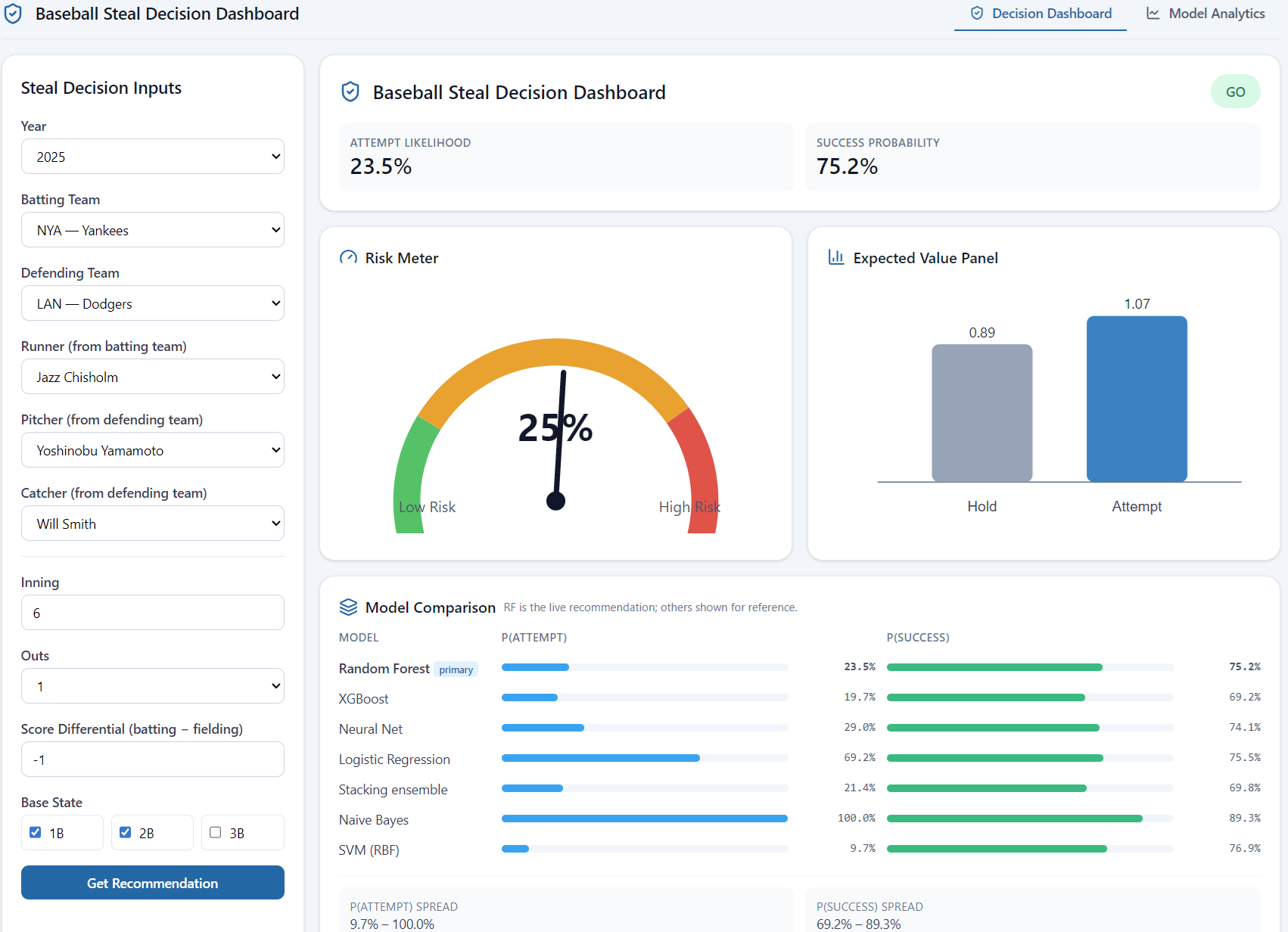
React, D3.js, FastAPI, PostgreSQL, scikit-learn, XGBoostA live Go/No-Go dashboard for MLB stolen-base decisions. Two models per situation, one for attempt likelihood and one for success likelihood, feed an expected-value engine alongside a 24-state Markov run-expectancy matrix.
Watch the demo Project poster Code
Built on about 2M play-by-play events from Retrosheet joined with Statcast player metrics (2015 to 2025), covering about 387K steal opportunities. Trained on 2015 to 2020 and tested on 2021 to 2025.
Compared seven classifiers by AUC-ROC, since accuracy misleads when only 7% of opportunities end in an attempt. XGBoost scored best on attempt prediction at 0.804, and a Random Forest (0.789) powers the live dashboard. Success prediction sits around 0.58 across models, in line with prior research.
Built with a team of four at Georgia Tech. I worked across the React/D3 frontend, the data pipeline, and model development and evaluation.
Algorithmic Trading Strategy Evaluation (Q-Learning)
Python, NumPy, pandasFramed single-stock trading as a reinforcement learning problem: a Q-Learning agent with Dyna-Q planning over discretized MACD, Momentum and Stochastic Oscillator states (1000 states, 3 actions).
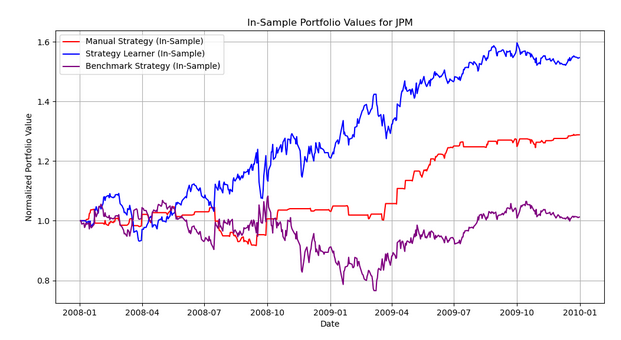
On JPM in-sample (2008 to 2009), the learner returned about 55% cumulatively, against 28.8% for a hand-built rules strategy and 1.2% for buy-and-hold. Its Sharpe ratio fell from 3.45 to 0.73 as simulated market impact rose from 0% to 5%.
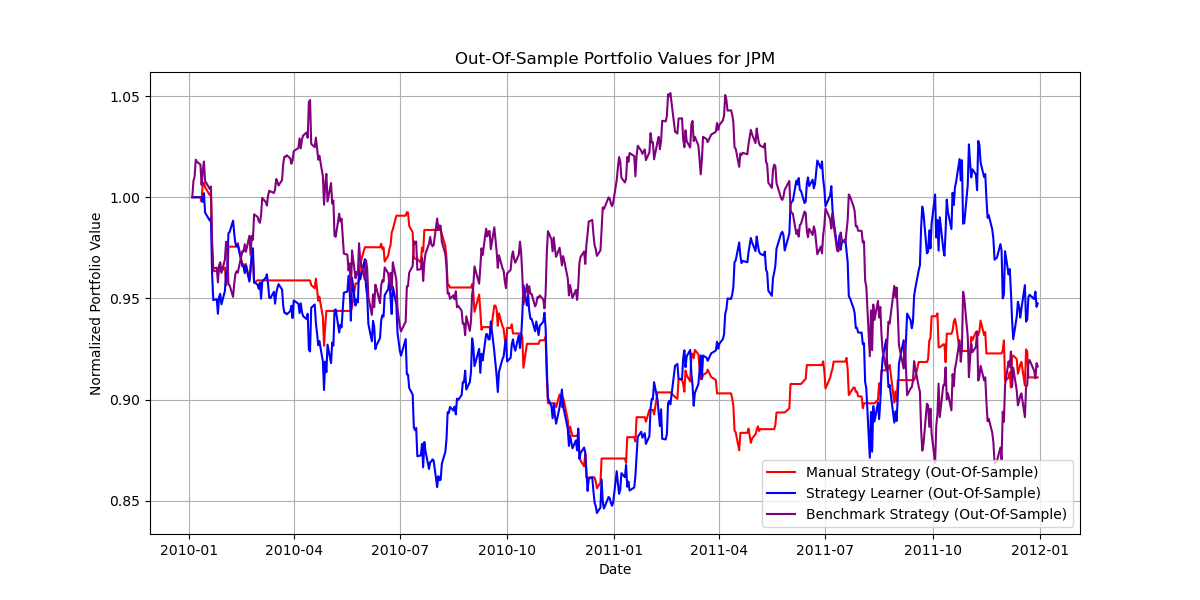
Out of sample (2010 to 2011) that edge mostly disappeared. All three strategies lost money, and the learner finished only slightly ahead of buy-and-hold. I attribute this to overfitting: the training window was the post-2008 recovery, a strongly trending market, and the test window was choppier with shorter-lived trends.